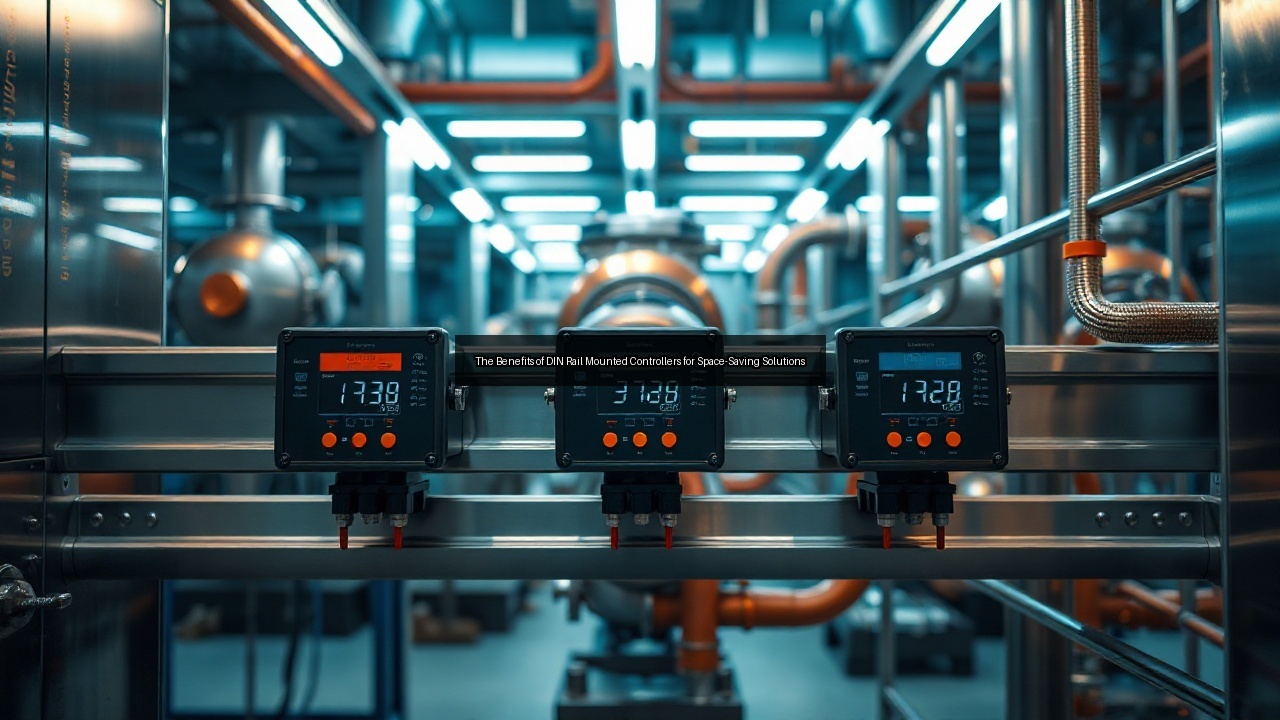
The Benefits of DIN Rail Mounted Controllers for Space-Saving Solutions
Understanding DIN Rail Mounted Controllers
What is a DIN Rail Mounted Controller?
A DIN rail mounted controller snaps directly onto standardized metal rails inside control panels, delivering compact process temperature controller functionality without bulky enclosures. Engineers mount these units in seconds by clipping them into place, which eliminates custom drilling and frees up valuable cabinet space. The design supports thermocouple inputs, RTD sensors, and infrared temperature measurement for precise readings across industrial environments. Users program setpoints through intuitive interfaces or software tools, allowing the device to compare measured temperature against desired values and adjust outputs accordingly. This approach integrates seamlessly with automation systems that require reliable regulation of heaters, chillers, and other process equipment.
The 35 mm DIN rail standard, established decades ago by European manufacturers, provides a universal mounting platform that ensures mechanical compatibility across vendors. Modern controllers incorporate spring-loaded clamps that grip the rail securely even under vibration, while integrated grounding contacts eliminate separate earth wiring. Because the units sit entirely inside the enclosure, exposed front-panel components are minimized, improving both safety and electromagnetic shielding in noisy factory settings.
Types of DIN Rail Controllers
Manufacturers offer several varieties of DIN rail controllers tailored to specific needs. Single-loop models handle basic temperature control tasks, while multi-loop units manage multiple zones simultaneously. PC-programmable controllers accept configurable inputs and outputs, supporting everything from simple thermostats to advanced PID controllers. Some versions incorporate RS-485 and Modbus communication for network integration, enabling remote monitoring and data logging. Others focus on specialized signals such as pressure or humidity alongside temperature. Selection depends on the required accuracy, number of channels, and communication protocols needed for the application.
Advanced models now include Ethernet/IP or PROFINET options for direct connection to modern PLCs and cloud gateways. Users can also choose between fixed I/O versions optimized for cost and modular designs that accept plug-in expansion cards for additional analog outputs or digital inputs. Firmware supporting user-defined logic allows simple sequencing tasks—such as staged heater startup—to be handled locally without burdening the main controller.
Comparison with Panel-Mount Controllers
Panel-mount controllers require cutouts and screw mounting that consume front-panel real estate, whereas DIN rail versions tuck away inside enclosures. This shift reduces wiring complexity and simplifies upgrades because technicians replace units without disassembling entire panels. Process temperature controller options on DIN rails often match or exceed the precision of traditional surface-mount control options while occupying far less volume. Maintenance teams appreciate the modular layout that speeds troubleshooting and minimizes downtime during calibration procedures. Overall, DIN rail designs deliver equivalent performance in tighter footprints.
Because the display and keypad are eliminated from the front of the panel, operators rely on HMI screens or mobile apps for visualization. This separation also allows the same controller hardware to be used in both visible and hidden locations, simplifying spare-parts inventory. In hazardous-area applications, the DIN rail approach permits the controller to remain inside a purged or explosion-proof enclosure while still providing full functionality.
Advantages of DIN Rail Mounted Controllers
Space-Saving Design
DIN rail mounting packs high-density functionality into narrow cabinets, freeing floor space for additional equipment. A single process temperature controller on a rail can replace larger panel-mount units, allowing more channels per enclosure. This compact arrangement proves especially valuable in retrofit projects where existing panels lack room for expansion. Engineers route wiring neatly along the rail, reducing clutter and improving airflow for better thermal management. The result is cleaner installations that accommodate growing automation demands without costly cabinet replacements.
Typical 22.5 mm or 45 mm wide housings let engineers fit eight or more independent loops inside the width previously occupied by one 1/4 DIN panel meter. When combined with side-by-side terminal blocks and slim relays, the entire control layer can occupy less than 150 mm of rail length per loop, dramatically increasing channel density in MCC rooms or skid-mounted systems.
Ease of Installation and Maintenance
Technicians install DIN rail controllers by snapping units into position and connecting wires via plug-in terminals. No special tools or extensive panel modifications are necessary, which shortens commissioning time. When calibration or firmware updates arise, workers swap modules quickly without disturbing neighboring devices. Built-in diagnostics alert operators to sensor faults or communication issues over RS-485 links. These practical features lower labor costs and keep processes running smoothly across continuous operations.
Hot-swap capability is increasingly common; removing a module while powered does not affect the remaining loops because each unit carries its own isolated power supply and communication transceiver. Replacement typically takes under two minutes, including parameter cloning via optional memory cards or Bluetooth adapters.
Cost-Effectiveness
Lower material and labor expenses make DIN rail solutions attractive for budget-conscious projects. Smaller enclosures cost less to fabricate, and standardized components reduce inventory needs. A process temperature controller with PID control and Modbus support delivers advanced features at competitive prices compared with custom panel builds. Long-term savings accumulate through reduced downtime, easier scaling, and fewer replacement parts. Facilities achieve reliable temperature measurement and regulation without overspending on hardware.
Because the same controller family can serve OEM machinery, laboratory equipment, and large-scale plants, purchasing volumes increase and per-unit pricing decreases. Standardized mounting also simplifies documentation and training, further lowering lifetime ownership costs.
Key Features of Process Temperature Controllers
PID Control for Accurate Temperature Regulation
PID control algorithms continuously calculate the difference between actual temperature and setpoint, then adjust output power to minimize overshoot and oscillation. This method delivers stable performance in dynamic environments where loads change rapidly. Modern DIN rail units implement auto-tuning routines that optimize proportional, integral, and derivative terms without manual intervention. Operators achieve tight regulation suitable for sensitive processes such as semiconductor manufacturing or pharmaceutical drying. The result is consistent product quality and energy efficiency.
Many units now include adaptive tuning that continuously refines PID parameters during production, compensating for changes in thermal mass or ambient conditions. Advanced algorithms such as model-predictive control are also appearing in DIN rail form factors, offering faster settling times for batch processes.
Configurable Inputs and Outputs
Flexible I/O configurations let users adapt a single process temperature controller to varied sensors and actuators. Thermocouple, RTD, voltage, and current inputs cover most temperature measurement requirements, while relay, SSR drive, and analog outputs drive heaters or valves. Additional channels monitor pressure or humidity for integrated process controls. Configuration software simplifies setup, allowing engineers to assign functions and scaling factors in minutes. This versatility reduces the need for multiple specialized devices.
Universal input circuitry automatically detects sensor type and linearizes the signal, eliminating jumper settings. Output modules support both time-proportioning and continuous analog modes, while optional digital outputs can drive external solid-state relays directly at up to 30 mA.
Support for RS-485 and Modbus Communication
RS-485 interfaces combined with Modbus protocol enable seamless data exchange between controllers and supervisory systems. Operators read real-time temperature values, adjust setpoints, and log trends from a central workstation. Multiple controllers share a single twisted-pair cable, lowering wiring costs in large installations. Alarm conditions transmit instantly, supporting rapid response to deviations. Integration with PLCs and SCADA platforms becomes straightforward, enhancing overall automation visibility.
Modbus RTU remains the workhorse protocol, but many devices also implement Modbus TCP over Ethernet for higher bandwidth and easier IT integration. Diagnostic registers provide insight into sensor health, output duty cycle, and internal temperatures, enabling predictive maintenance strategies.
Applications in Automation and Industrial Settings
Temperature Control in HVAC Systems
HVAC equipment relies on DIN rail mounted process temperature controllers to maintain comfortable zones while minimizing energy use. Units read multiple sensors and modulate dampers, fans, and heating coils through PID loops. Communication over Modbus allows building management systems to coordinate dozens of controllers for optimized performance. Precise regulation prevents temperature swings that affect occupant comfort and equipment longevity. Installers appreciate the compact size that fits inside crowded mechanical rooms.
In variable-air-volume systems, individual controllers manage reheat coils while sharing zone temperature data with the central BMS. Night-time setback and demand-controlled ventilation strategies are easily implemented through scheduled setpoint changes transmitted over the network.
Humidity and Pressure Monitoring Solutions
Many processes demand simultaneous control of humidity and pressure alongside temperature. DIN rail controllers accept additional transducers and apply independent PID loops to maintain all variables within tight tolerances. In cleanrooms and drying ovens, accurate measurement prevents defects and ensures compliance. Configurable alarms trigger corrective actions before conditions drift outside acceptable ranges. This multi-variable capability consolidates hardware and simplifies system architecture.
Pharmaceutical stability chambers, for example, require simultaneous control of temperature, relative humidity, and differential pressure. A single multi-loop DIN rail controller can manage all three loops while logging data for regulatory audits.
Use in Heater Control Equipment
Heater control equipment benefits from the fast response and high accuracy of DIN rail PID controllers. Applications range from plastic extrusion to food processing, where consistent heat delivery determines product quality. Thermocouple inputs provide direct feedback, and configurable outputs drive solid-state relays or contactors. Remote monitoring via RS-485 keeps operators informed of performance trends. Robust construction withstands harsh industrial conditions while delivering reliable operation.
In extrusion lines, multiple zones along the barrel and die each receive dedicated control loops. Cascade control strategies—where an inner loop regulates heater temperature and an outer loop maintains melt temperature—are readily implemented within the same compact module.
Choosing the Right Process Temperature Controller
Factors to Consider: Precision and Accuracy
Precision and accuracy determine how closely a controller maintains the desired temperature. Look for devices with high-resolution inputs and low drift specifications to support demanding applications. Calibration certificates verify performance at installation and during periodic checks. Consider the sensor type—thermocouples offer wide ranges while RTDs provide superior stability. Matching controller specifications to process requirements avoids unnecessary expense while ensuring reliable temperature measurement.
Environmental factors such as operating temperature range, humidity tolerance, and electrical noise immunity should also be evaluated. Units rated for –20 °C to +60 °C with 95 % RH non-condensing operation provide headroom in most industrial cabinets.
Calibration and Measurement Techniques
Regular calibration maintains measurement integrity across the operating range. Users compare controller readings against certified references and apply offset corrections through built-in menus. Infrared sensors require separate emissivity adjustments for non-contact applications. Documented procedures and traceable standards help facilities meet quality audits. Proper technique extends equipment life and prevents costly process deviations caused by sensor drift.
Many modern controllers support one-point or two-point calibration routines that can be performed while the process remains online, minimizing production interruptions. Audit logs record who performed each calibration and when, satisfying traceability requirements.
Exploring Options: 16 DIN vs 32 DIN
Size standards such as 1/16 DIN and 1/32 DIN refer to traditional panel cutouts, yet DIN rail equivalents offer comparable functionality in even smaller packages. The 1/32 DIN format suits space-constrained locations where minimal width matters most. Larger 1/16 DIN units provide extra display area and more I/O options when front-panel visibility is required. Evaluate mounting style, display needs, and expansion requirements before final selection. Matching the controller to available rail space ensures efficient use of every inch inside the enclosure.
When front-panel indication is unnecessary, the narrowest DIN rail housings (often 12.5 mm or 17.5 mm) deliver the highest channel density. Conversely, if local display and keypad access remain important, wider modules with integrated OLED screens strike the best balance between compactness and usability.